



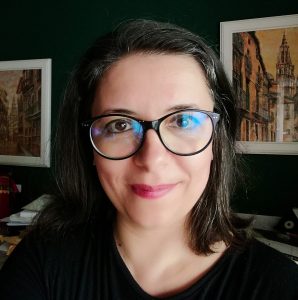
 Silvia-Alexandra Ștefan is a Lecturer, PhD at the Department of Romance, Classical and Modern Greek Languages and Literatures, at the Faculty of Foreign Languages and Literatures in the University of Bucharest. Her main investigation interests focus on the Spanish Golden Age Poetry, History and Poetics Theory, as well as on their Medieval, Renaissance and Classical Antiquity sources.
You were awarded an ICUB Young Researchers Grant, carried out at ICUB Humanities in 2019. What made you apply for this grant competition?
Yes, that is correct, I have benefitted from an ICUB Young Researchers Grant for one year, between 1st of February 2019 and 31st of January 2020. Several years ago, one of my colleagues at the English Department, Sorana Corneanu, organized a workshop at ICUB-Humanities, on the topic of Early Modern Imagination. I was interested, so I came to listen to the speakers at this workshop and this is how I first came to ICUB-Humanities. I could see back then the programme with the various events they were offering and I started to attend their Grant Writing Seminar, leaded back then by Mihnea Dobre and Ionuț Epurescu Pascovici. The Grant Writing Seminar is great way not only to start looking for grants, but also to learn how to apply and get one, obviously. And this is where and how the idea of me applying for this grant naturally and spontaneously arose.
 Could you detail a bit your research topic? What sparked your interest in the Spanish Golden Age?
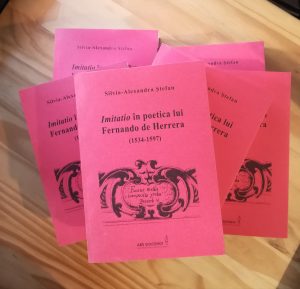
My research topic has been From Famagusta to Lepanto: Spain between Cultural Inferiority and Imperial Aggrandizing. It is a study about the appropriation of literature by imperial ideology in sixteenth-century Spain and it is focused on Fernando de Herrera´s writing Relación de la guerra de Cipre y sucesso de la batalla naual de Lepanto (Seville, 1572). And it is, as its name suggests, an account of the battle of Lepanto, historically and poetically written. I had previously defended my PhD thesis on the concept of imitation in Anotaciones a la poesia de Garcilaso (1580), which actually was the commented edition of Garcilaso´s poems by Herrera, a poetics theory masterpiece intended to teach poets of his time how to use literary tradition in order to enhance patriotic and imperial ideals and ideology. And I had chosen Herrera´s writings among others´ when I wrote my final diploma paperwork on Poetics Theory and Practice during the Spanish Renaissance as an undergraduate student.
How do you see the relation between your research and teaching at the Faculty of Foreign Languages and Literatures?
I believe it is very important for a teacher to maintain as much as possible his or her connection with the research activity in their field of studies. Even if this is often very hard to do, because teaching can eat up a lot of time preparing, sometimes all of your time and even more. I mean, I often feel and say that if I did not sleep at all, still, I would not have enough time to prepare as I would see fit. Nevertheless, keeping connected with the research activity not only brings a fresh and updated touch to one´s teaching activity, but also keeps one´s curiosity alive and I strongly believe that this attitude of inquiring and feeling the imperious need to look further on into knowledge that research brings forward is one of the most important value that we should be handling over to our students.
 What impact did the ICUB Grant have on your research? Which are, in your opinion, the main advantages of applying for an ICUB Grant?
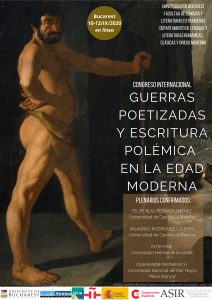
It has had a huge impact and still has one. I was able to do a lot more that I could do before I had the grant. I could go to conferences I did not stand a chance to attend before, because of the expenses they meant and I could thus connect lively to pretty much most of the colleagues in my field. This is how many of my activities were made possible. And I refer to the workshop I organized at ICUB-Humanities on 4th September 2019, on the topic of Poetry and History. Representations of Lepanto, attended by professors from King´s College London and University of Liverpool, amongst others, who had been recommended by one of my project´s reviewers. And I also refer to the congress I am organizing at ICUB-Humanities, online, this fall, on 10-12th September on the topic of Poetized Wars and Polemic Writing the Modern Age, when many of the professors I met at conferences during my research grant will attend.
Do you plan to continue collaborating with the ICUB? In what form?
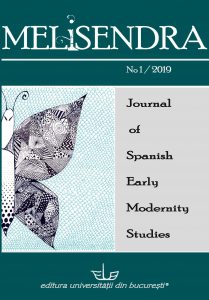 Absolutely. I have created an investigation group, named Spanish Early Modernity Studies – that is to be soon affiliated at ICUB-Humanities. Within the group we have started publishing a journal – Melisendra. Journal of Spanish Early Modernity Studies, the first issue has been released and we are preparing the second one by the end of this year. I have also planned another international workshop, on the topic of Centre and Peripheries. The Idea of Europe in the Middle Ages, Early Modernity and Beyond, organized at ICUB-Humanities, together with other three international networks: Language Acts and Worldmaking ‘Travelling Concepts’ strand, (King’s College London), Seminario de Poética del Renacimiento ‘Censura, textualidad y conflicto’ (Universitat Autònoma de Barcelona), and the project ‘Leer y escribir la nación: mitos e imaginarios literarios de España (1831-1879)’ (Universidad de Cádiz). This workshop was supposed to happen this year in June, but, because of the current state of affairs with the pandemic, we have postponed it until June 2021, when hopefully we will be able to meet in person.
After a year at ICUB, would you recommend to other young researchers from the University of Bucharest to apply for an ICUB Grant?
Yes, of course, I have always gladly promoted ICUB-Humanities announcements in all groups I am part of. ICUB-Humanities is a great place to start and develop one´s research in a friendly environment and surrounded by professionals. I am convinced it is a great opportunity that as many researchers should benefit of.