


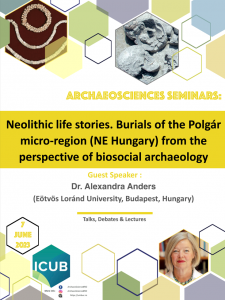
The Research Institute of the University of Bucharest (ICUB) is pleased to announce the 33 ArchaeoSciences Seminar.
These seminars are an original initiative of the ArchaeoScience#RO Platform at ICUB that aims to provide a setting for professionals in the Archaeological Sciences field from different parts of the world to share knowledge and transmit meaningful information about the latest issues regarding the current methods and approaches used to study the past. It is also a chance for Romanian students to learn more about the various interdisciplinary aspects of archaeology.
This seminar will take place on 7 June 2023 at 11:00 am (EET), and our guest speaker is Dr. Alexandra Anders from Eötvös Loránd University, Budapest (Hungary).
She will give a lecture entitled “Neolithic life stories. Burials of the Polgár micro-region (NE Hungary) from the perspective of biosocial archaeology”.
Dr. Alexandra Anders is a qualified (habil.) Senior Research Fellow in the Department of Archaeometry, Archaeological Heritage and Methodology, Institute of Archaeological Sciences, Eötvös Loránd University, Budapest, Hungary. Her main research field is the Neolithic of the Carpathian Basin, with a focus on the archaeology of death and the archaeology of gender. She has directed or participated in numerous excavations in the Polgár area of northeastern Hungary. Her current interests include the biosocial archaeological study and assessment of Neolithic burials discovered in this eastern Hungarian micro-region in order to gain a better understanding of the life of the communities who settled there. She is also responsible for teaching courses in museum studies and for the archaeological heritage specialisation at the Institute. She was the main organiser of the EAA 28th Annual Meeting in Budapest in 2022 and published many monographs, co-edited volumes, studies, reports and articles.
In the planned lecture, she will present the multidisciplinary approaches applied in one of the most interesting archaeological areas from Hungary. During the excavations preceding the motorway construction in the 1990s, conducted on the outskirts of Polgár in NE Hungary, more than 300 burials were brought into light at eight different sites (among them Polgár-Ferenci-hát and Polgár-Csőszhalom) from the Middle and Late Neolithic periods 5500–4550 cal BC. A project was started in 2017 to investigate these burials with multidisciplinary methods to better understand the life of the Neolithic people. The presentation will summarise the main results of this ongoing project. The multidisciplinary methods of the project comprise the traditional archaeological and bioarchaeological investigations and analyses, such as physical anthropology and pathology, stable isotope (δ13C, δ15N) chemistry and 14C measurements, micro archaeobotany on dental calculus, and paleogenetic data for kinship patterns. The different artefacts (personal adornments made by Spondylus or red deer canines, the lithics and ochre) placed in the burials were also analysed by microscopic use-wear analysis and provenance studies (petrography, SEM-EDX, PGA). The results of this complex, but basically archaeologically-oriented methods complement each other and thus we are able to trace the possible changes of lifestyle through space and time. With the aid of these results, micro-histories of given communities, as well as personal life histories of certain individuals are both traceable. The individuals and their artefacts have different biographies and by weaving together the strands of these different biographies and interpreting them in the context of the grave we gain an insight to understand the life of Neolithic people in Polgár.
This event will take place Wednesday, 7 June 2023, starting at 11:00 am (EET) at the Faculty of Biology, in the Conference Room of the Research Platform in Biology and Systematic Ecology (Splaiul Independenței, no. 91-95, Bucharest).
We look forward to exciting discussions!
ArchaeoScience#RO Team