


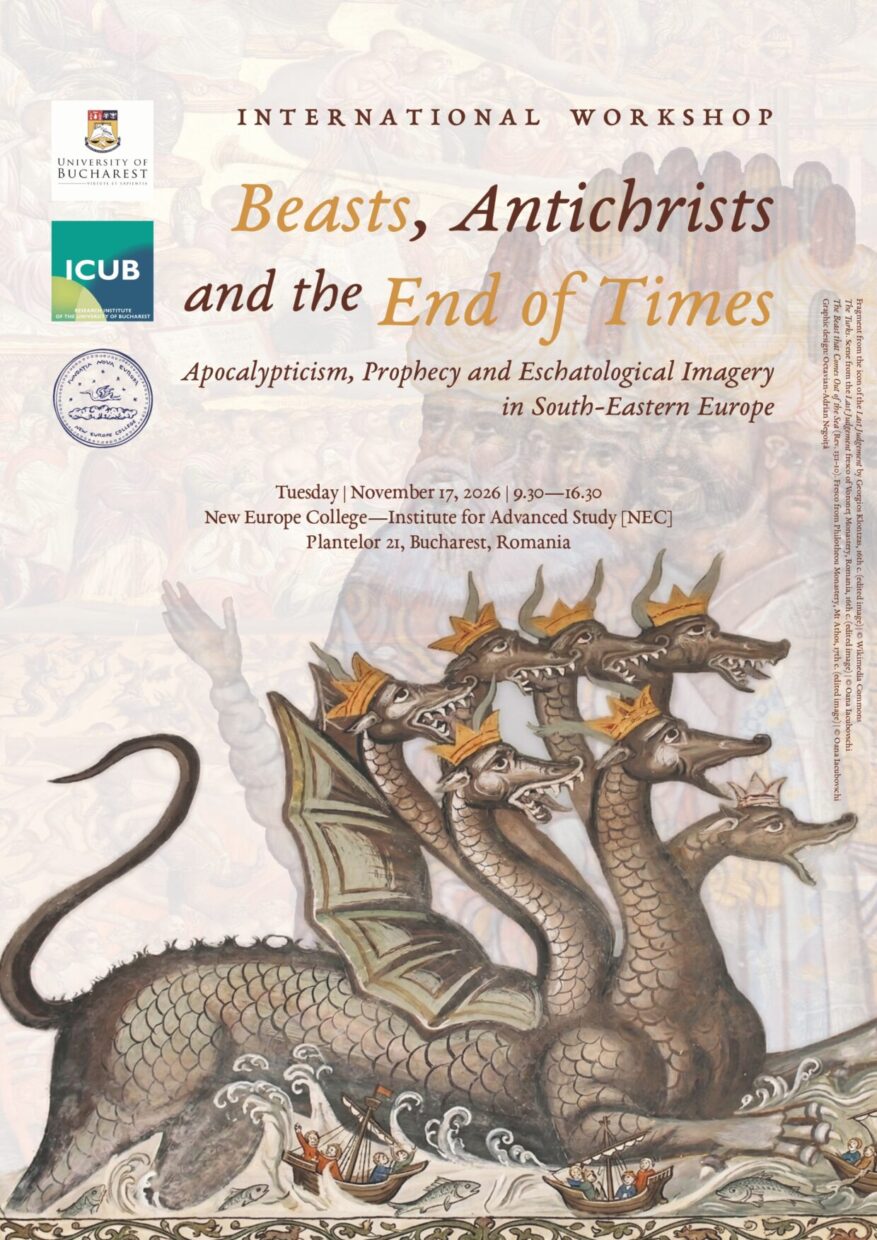
International Workshop
Tuesday | November 17, 2026 | 9.30—16.00
New Europe College—Institute for Advanced Study [NEC]
Plantelor 21, Bucharest, Romania
Convenor: Octavian-Adrian Negoiță (ICUB Fellow)
This workshop explores the complex and multifaceted interactions between apocalyptic thought, prophecy, eschatological expectations, biblical exegesis, and visual culture in South-Eastern Europe from the 15th to the early 19th century. Positioned at the crossroads of empires, confessions, and intellectual traditions, the region offers particularly fertile ground for examining how scriptural interpretation, prophetic discourse, and eschatological speculation intersected with political upheaval, religious reform, artistic production, and cultural exchange.
Apocalypticism, understood broadly as a mode of interpreting history through the lens of divine revelation and ultimate transformation, played a significant role in shaping the region’s religious, intellectual, and artistic life. Prophecy likewise provided a flexible language through which individuals and communities interpreted the past, made sense of contemporary crises, and imagined possible futures. In South-Eastern Europe, these traditions developed within a pluralistic environment marked by the coexistence and interaction of Orthodox, Catholic, Protestant, Jewish, and Islamic communities. The workshop investigates how different groups engaged with biblical texts—especially prophetic and apocalyptic books—and how their interpretations were articulated through commentaries, historical narratives, prophetic traditions, and iconographic programs.
A central concern of the workshop is the relationship between exegesis, prophecy, and historical experience. Interpreters, writers, and artists did not approach biblical texts and motifs in isolation, but their readings and representations were deeply embedded in the political, social, and confessional dynamics of their time. Ottoman expansion, Habsburg-Ottoman conflicts, the Reformation and Counter-Reformation, dynastic change, and shifting patterns of patronage and intellectual exchange all contributed to heightened senses of historical urgency and eschatological expectation. Prophecies could be reinterpreted and adapted to explain political change, legitimize particular actors, identify enemies, or anticipate the collapse and renewal of empires and communities. The papers consider how such contexts shaped interpretations of figures and themes including beasts, Antichrists, tribulation, sacred cities, Enoch, and the end of dynasties—and how these interpretations, in turn, informed perceptions of crisis, identity, history, and destiny.
The workshop also foregrounds the transregional and transcultural dimensions of apocalyptic and prophetic thought. South-Eastern Europe functioned as a zone of intense intellectual and artistic circulation, in which ideas, texts, images, prophecies, and interpretive frameworks moved across linguistic, confessional, and imperial boundaries. Languages served as vehicles for the transmission and transformation of apocalyptic, prophetic, and exegetical traditions. By bringing together scholars working on diverse textual, historical, and visual corpora, the workshop seeks to foster a comparative perspective that highlights both shared patterns and distinctive local developments.
Brochure Eschatological Imagery
Program:
9.30-9.45 Constantin Ardeleanu | Octavian-Adrian Negoiță
Registration and Introductory Remarks
9.45-10.15 archim. Policarp Chițulescu
Anciens commentaires du Livre de l’Apocalypse conservés dans la Bibliothèque du Saint-Synode du Patriarcat Roumain
10.15-10.45 Andrei Prohin
Andrew of Caesarea’s Commentary on the Revelation in the Slavic Manuscripts from the Romanian Lands
10.45-11.15 Aleksandar Z. Savić
The Seven-Hilled City: (Sacred) History and Prophecy in Constantine of Kostenets
11.15-11.30 Break
10.30-12.00 Nikolas Pissis
The “Ten Days of Tribulation” (Rev 2:10): Exegetic Fortunes of an Apocalyptic Theme
12.00-12.30 Marinos Sariyannis
End of the Dynasty and End of Times: Ottoman Views on the Future from Eschatology to Historical Sociology
12.30-13.00 Mihai-Cristian Amăriuței | Lidia Cotovanu | Despoina Lambada | Ovidiu Olar | Yorgos Tzedopoulos
The Lion, the Convert and the Queen: A 1821 Painting and Its Prophetic Context
13.00-14.00 Lunch break
14.00-14.30 Cristina Bogdan
Saint Jean dévorant le Livre: Représentations dans l’iconographie eschatologique roumaine
14.30-15.00 Elisabeta Negrău
The Trial of History: Shaping the Brancovan Church Entrance Programs
15.00-15.30 Vlad Bedros
Revisiting the “Interiorized Apocalyptic” Tradition: A View from Inside a Moldavian Church
15.30-15.45 Break
15.45-16.15 Octavian-Adrian Negoiță
Beasts, Antichrists and the End of Times: Georgios Koressios (cca 1570–1659/60) and His Reading of the Apocalypse of John
&
Concluding Remarks
Speakers and Affiliations:
Mihai-Cristian Amăriuței | Institute of History “A.D. Xenopol”, Romanian Academy
Vlad Bedros | National University of Arts & Institute of Art History “G. Oprescu”, Romanian Academy
Cristina Bogdan | University of Bucharest
archim. Policarp Chițulescu | Library of the Holy Synod of the Romanian Patriarchate
Lidia Cotovanu | Institute of History “Nicolae Iorga”, Romanian Academy
Despoina Lambada | University of Ioannina
Elisabeta Negrău | National University of Arts & Institute of Art History “G. Oprescu”, Romanian Academy
Ovidiu-Victor Olar | Institute of Habsburg and Balkan Studies, Austrian Academy of Sciences & Institute of History “Nicolae Iorga”, Romanian Academy
Nikolas Pissis | Ionian University
Andrei Prohin | Museum of Ethnography and National History, Chișinău
Marinos Sariyannis | Institute for Mediterranean Studies/FORTH in Rethymno
Aleksandar Z. Savić | University of Belgrade
Yorgos Tzedopoulos | University of Ioannina
This international workshop is organized within the ICUB Fellowship for Young Researchers, offered by the Research Institute of the University of Bucharest (ICUB), contract no. 13139/16.12.2025, and it is hosted by New Europe College—Institute for Advanced Study [NEC].