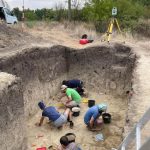
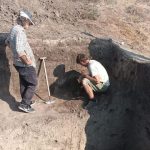
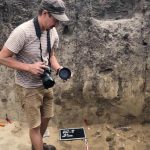
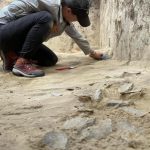
The University of Bucharest, through the ArchaeoSciences Platform within the Research Institute of the University of Bucharest (ICUB), in partnership with the Museum of Bucharest, Oltenița Cultural Directorate, University of Kiel, Vasile Pârvan Institute of Archaeology, and the Lower Danube Museum Călărași, participated this year in archaeological research conducted at a Palaeolithic settlement within the Gumelnița archaeological site (Oltenița, Călărași County).
The project, initiated in 2017, has the general objective of assessing the archaeological potential of the site through interdisciplinary approaches (field research, coring, geophysical surveys, sample collection, etc.) with the ultimate goal of reconstructing the paleoenvironmental and anthropic characteristics that shaped prehistoric habitation in the area.
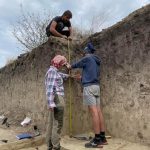
In 2022, the research campaign brought an exciting discovery – a Palaeolithic level within the necropolis near the eponymous Gumelnița site (Măgura Gumelnița tell settlement). Consequently, during this year’s campaign, which took place from September 15th to September 22nd, 2023, specialist teams focused their efforts on exploring the Palaeolithic occupation levels, located 2 meters below the current ground level.
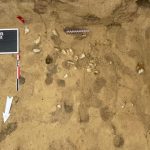
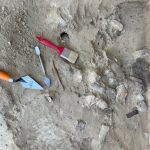
In the current campaign, the research team aimed to deepen the study of this level on a 12 m2 area. Upon reaching the Palaeolithic layer, abundant flint debitage remnants were identified, grouped in various zones, attesting to the existence of a seasonal camp for processing flint objects from the Upper Palaeolithic. Dating, assisted by colleagues from Babeș-Bolyai University Cluj-Napoca (Faculty of Environmental Science and Engineering), indicates an age of 18±2 ka BP.
The team involved in field and laboratory research comprised researchers and archaeologists from ICUB (Gabriel Popescu, Theodor Ignat, Vasile Opriș, Cristina Covătaru, Adrian Șerbănescu, Cristian Roth, George Gănescu, Ana Garcia-Vasquez, Aurelien Tafani, Daniel Stoicescu, Valentin Radu, Cătălin Lazăr), Museum of Bucharest (Vasile Opriș, Theodor Ignat, Adelina Darie, Vlad Bindea), Vasile Pârvan Institute of Archaeology of the Romanian Academy (Adrian Bălășescu, Mihaela Golea, Gabriel Vasile), Gumelnița Civilization Museum in Oltenița/Oltenița Cultural Directorate (Silviu Cristache, Moise Cosmin), Lower Danube Museum Călărași (Valentin Parnic), Faculty of History of the University of Bucharest (Carol Căpiță), Faculty of Geography of the University of Bucharest (Laurențiu Țuțuianu, Alfred Vespremeanu-Stroe), and Faculty of Environmental Science and Engineering of Babeș-Bolyai University Cluj-Napoca (Alida Timar-Gabor, Daniela Constantin).
The documentation and recording of archaeological contexts and discovered materials were ensured through the use of an interdisciplinary methodology. In-situ mapping of materials was performed using photogrammetry, facilitated by a DSLR Nikon D780 camera and an unmanned aerial vehicle (UAV) DJI Mavic 2 Pro. With millimetric accuracy and precision, flint artifact recording was carried out using a Leica FlexLine TS06 total station. Further data, including a series of absolute datings, will be published after field data processing and the analysis of lithic materials and collected samples.