


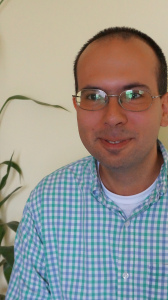
 Andrei Mărăsoiu received a PhD in Philosophy from the University of Virginia in May 2019, writing a dissertation titled “What is it to understand?” and he was a fellow of the Jefferson Scholars Foundation. His ICUB project carried his dissertation work farther, now more specifically concerned with the epistemic import of conscious episodes often called insights, or “Aha!” experiences. Do any phenomenal properties unify such episodes? And do such phenomenal properties somehow correspond to the epistemic benefits we reap from having such experiences?
As of September 2020, Andrei is an Assistant Lecturer at the Department of Theoretical Philosophy, University of Bucharest.
We can say that you are a long-term ICUB collaborator. You started in 2017, as a convener of the Topics in Understanding research seminar, continued as a fellow in 2020, and now you will conduct an UEFISCDI postdoctoral grant. Why ICUB?
ICUB is a long-standing institutional friend of mine. Before leaving for the US, I received an MA degree in the History and Philosophy of Science, in 2010, and a part of my work within that program involved topics that were later prominent on ICUB’s research agenda. There was an overlap between my research and the main topics covered at ICUB, so right from the get-go there was this feeling that this is a natural home for me. Naturally, when I had the opportunity to start writing on my dissertation, I thought, well, how could I jumpstart the project by not brainstorming all alone about these things? In Summer 2017, I organized this reading group – I think I was formally called „a convenor”, which is, you know, a nice title – and I had the opportunity to meet many friends, to meet some of them anew. Throughout the summer I think we had 7-8 sessions, one every two or three weeks, and it was really a pleasure. I didn’t expect there’d be so much interest and so much eagerness to participate and to share thoughts and debate. This really was a tremendous help for me in getting me thinking about what I should write in my dissertation. Of course, since this is philosophy, I disagreed with almost everyone else, with different people on different things, and so did everybody else. It was a true pleasure because they expected it. And from this playful to and fro some very interesting thoughts developed; I’m still collaborating with participants, jointly writing manuscripts, having other projects in the works, and it’s been quite a beautiful event.
Could you detail your research topic a bit?
I graduated the PhD program in May 2019 with a dissertation titled „What is understanding?”, and that’s also when I wrote this ICUB project which was closely related. The ICUB project was called „What are insights?” An insight, or an „Aha” experience, is a moment when it dawns on you that something is true; or something is seen to have an aspect or property that wasn’t apparent beforehand. And once you see it, you realize that it cannot be otherwise. In a sense, you can see how the two projects relate. Once you have an insight, you gain understanding (typically). This doesn’t always happen, as sometimes insights misfire or they are misleading; but it happens often enough to be able to build a connection.
You returned to Bucharest after an MA and a PhD carried out in the USA. What was the experience of doing research in Romania again like for you?
I’m not an authority on this. I think this is a terrific question for those who work in education sciences: to study carefully and to draw comparative studies. Still, let me share some half-baked thoughts. I didn’t experience a huge shift in terms of expertise or content when I moved from Romania to the US. The main difference for me, in terms of academic progress and terms of institutional setup, was that I found a lot of structure to the education process. Key is a kind of work ethics. There’s no need to have overarching ambitions, bombastic goals or anything like that. Once you set yourself a small task, you go on and do it well and in a credible way, i.e., in a way where others can follow and understand and make suggestions for improvement. That ensures progress can be charted and monitored by the authorities that be. And it also gives a sense of achievement and fulfillment, both to myself as a student and to my advisor, committee members, or other faculty or institutional bodies I interact with. So I do have this sense that we shouldn’t see the US and Romania as two disconnected worlds. Rather, it’s as if there were two faces of the same coin. And that coin is doing good research – both by your lights, and by the lights of the would-be governing bodies supporting your research. I would say that setting afloat with this mindset builds a can-do attitude, working towards goals that aren’t too high or impossible to achieve.
What impact did the ICUB Fellowship have on your research? What are, in your opinion, the main advantages of applying for an ICUB Fellowship?
There are plenty of things to say here. As you can see, I’m struggling to contain myself to short answers. But it’s really difficult because I’m quite fortunate to be an ICUB Fellow. There are plenty of advantages in terms of logistics and infrastructure. The main thing I would say, though, is that there is a growing sense that ICUB is a very nice home for research. Any time you walk in within normal hours, you are likely to find several people working on their projects. Everyone is incredibly invested in their own projects, but also interested to broaden their horizons and hear new ideas. I found fellows doing interesting work on neighboring topics, and sharing their perspectives was incredibly helpful for me. So this feeling that ICUB is a newfound home for research, this was incredible for me. That’s noticeable in the fact that, since I became an ICUB fellow, my productivity skyrocketed, with plenty of published papers or papers accepted to be published. I expect that to go on. Because once you kickstart this process, it’s difficult to stop. You start writing, and you go on and on. But I’m not sure and I cannot really say whether it would have even been possible for me to engage in so many projects and carry some of them to completion had it not been for the ICUB Fellowship. I guess that is my main takeaway here.
What was your experience like when applying for a national grant, and why did you choose to conduct it at ICUB?
With the mindset I got as a young researcher, and given that the job market in philosophy is not terrific (to put it mildly), it was a good idea to apply for any workable opportunity. I was incredibly excited when I got the grant. The application process for UEFCISDI was easy and intuitive. I was very happy to see that. It was a swift learning curve for me. I was happy to have Professor Mircea Dumitru as a mentor; he has worked in areas germane to my project. I worked with him on my research proposal, and I was happy to see a lot of overlap in our research interests. My work on this grant is set to begin on September 1st and so I can only speak to the hopes I have, and the cautious optimism I embarked on this project with. It was a natural choice to pick ICUB Humanities as the hosting Institute within the University of Bucharest, because I had a wonderful time as a young researcher here. Of course, there will be many ways to collaborate with the Department of Theoretical Philosophy and with other interested departments. But I was happy to be an ICUB Fellow, and choosing it as a host for the new project seemed like the best thing to do.
Why do you think researchers should apply for the ICUB fellowship? Do you have a message for future applicants?
I think it’s a natural choice. My message for future applicants is to apply widely and wisely. On the one hand, you certainly want to take advantage of every possible opportunity you have. On the other hand, there is no point in applying somewhere where your research project isn’t a good fit. Although I’m not an experienced enough researcher to give advice, but speaking only from my personal experience, it seems that if a young researcher thinks she has a project that is workable within the topics and the infrastructure that ICUB has to offer, and they think they are a good fit, I think they should apply. They should seriously consider it even if they have other offers, as they will find a thriving and vibrant research community here, and that can only benefit their own projects.