


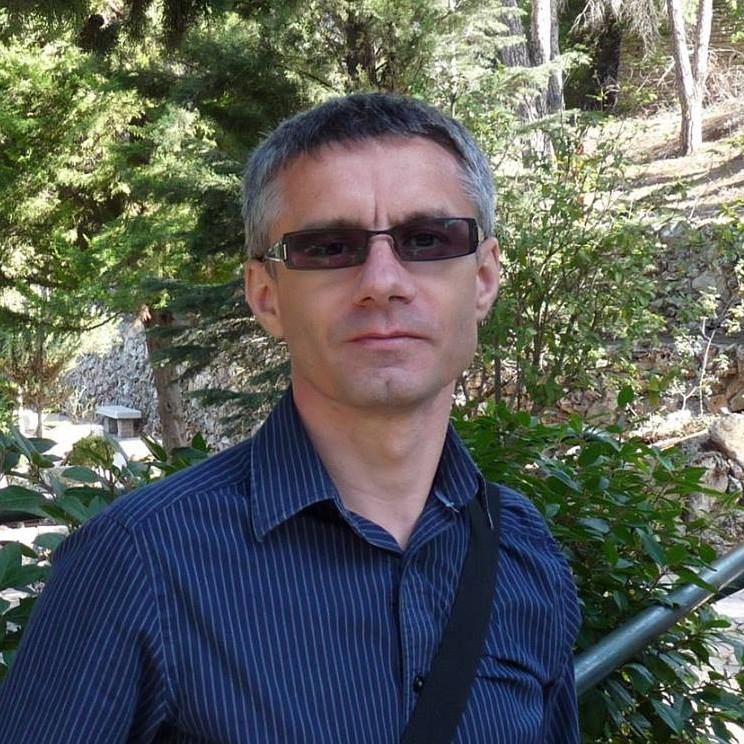
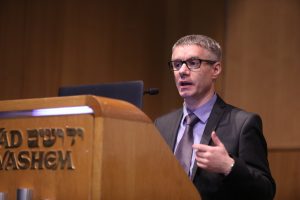
 Ion Popa is an Honorary Research Fellow of the Centre for Jewish Studies, University of Manchester, UK. He received his MA (2009) and PhD (2014) from the University of Manchester, and over the years has been the recipient of several prestigious fellowships and awards. He is a specialist on Modern/Contemporary European History, with a focus on the Holocaust, religion and politics, and inter-ethnic/inter-religious relations, with a particular attention to Jewish-Christian relations.
You were awarded an ICUB Fellowship for Young Researchers in 2019. What made you apply for this fellowship competition?
In my case, as in the case of many other ICUB fellows, there is a link between my application for ICUB and a previous application for a New Europe College fellowship. After about 11 years in which I was abroad (since 2007 I lived in England, in Manchester, where I did an MA and a PhD), in 2017 I applied for a NEC fellowship, which I was awarded for 2018 – 2019. During my stay at NEC I heard a lot about ICUB and some of my NEC colleagues were previously ICUB fellows or intended to apply for an ICUB fellowship. There is a link between the two institutions, ICUB and NEC, although it’s not a formal one, I think a lot of fellows from ICUB apply to NEC and vice versa. There is a similarity in the prestige of these fellowships, they attract young scholars, some of them educated abroad and wanting to return to Romania. When I met some people having fellowships at ICUB or working at ICUB, I became even more interested to apply because I discovered a high professional standard. From an academic point of view, I was impressed with ICUB and the links with NEC and the stand in the academic environment in Bucharest. But there was, also, a personal dimension of my decision to apply first to NEC and then to ICUB, and that decision had to do it with the fact that after many years of fellowships in many parts of the world (I was a fellow in Israel, in Germany, in USA, in Austria) I got a little bit tired and I wanted to come back for some time. Romania is the country in which I was born, I have my family here, so it was, in a sense, also a desire to settle a little bit, to return to the roots, somehow, and the ICUB fellowship offered me this possibility.
 Could you detail your research topics and interests?
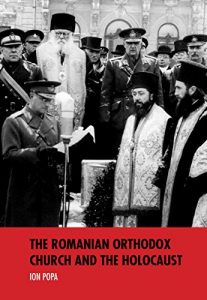
Yes, and I have to do it in a chronological way. When I left Romania, in 2007, I was very interested in religion and politics; actually, my MA was in religious and political life. At the time I knew about the Holocaust, but in 2007, in Romania, knowledge on this subject was still limited, not only about the Holocaust in Romania but about the Holocaust in general. During my MA I started discovering this topic and became more and more interested. This is how my focus on religion and politics shifted to Holocaust studies and my MA and then my PhD looked at the way in which the Romanian Orthodox Church behaved toward the Jewish community during and after the Second World War; this allowed me to combine my research in religion and politics with the study of the Holocaust. I am interested in church – state relations, Jewish – Christian relations, especially in the context of the Holocaust, the study of antisemitism with its Christian roots. After I finished my PhD, my next big project was about the Catholic Church in Romania during the Holocaust; it was a normal, actual continuation of my doctoral studies. By the way, the PhD resulted in a book, The Romanian Orthodox Church and the Holocaust, published by Indiana University Press in 2017. The second topic about the Catholic Church and the Holocaust in Romania resulted in a second book, which, hopefully, will be published by Cambridge University Press in the near future. This second book is focusing not only on the Romanian space but also on the attitude of the Vatican and the attitude of the Pope, which is a topic of high interest at the moment. My next projects are trying to understand the ways in which churches, as institutions, were important in creating the environment and atmosphere that led to the Holocaust. I already started looking at the interwar attitude of churches throughout Europe toward the Jewish community and the way in which they supported fascists, right – wing and extremist movements. Sometimes they even got themselves directly involved in politics, the case of Romania being one of the best, because we have the Patriarch, the leader of the Romanian Orthodox Church, who became Prime Minister in February 1938; this is an interesting case where a church official became so actively involved in front line politics. So, I am interested to see whether that happened in other parts of Europe, to what extent churches were involved in politics and influenced the policies against Jews. That is, in a nutshell, what I am looking at.
 As a researcher of the Holocaust, why do you think is it relevant to study and publish works on this topic?
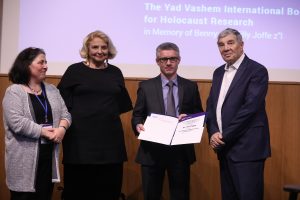
The Holocaust is a wide – ranging topic because it has implications for so many fields of study. I am a historian and I am trying to approach whatever I am researching from a historical perspective, but sometimes you have to put different hats as well. For example, I did a BA in theology and this is helping in understanding church behaviour, liturgy, why some aspects of church dogma, or history, or ritual are problematic. The Holocaust has ramifications in many fields: psychology, the study of armed forces, the study of sociology, of social sciences; a lot has been written, for example, on why normal individuals or ordinary men behaved as they behaved during the Holocaust, how was it possible for normal, regular people (although it is very difficult to define normality) to become such murderers. The study of the Holocaust is highly diverse and my part is to add my insight in religion and politics, in Jewish – Christian relations, in the history of antisemitism and especially in the Christian dimensions of antisemitism, to add this to the larger framework. As I said a little bit earlier, I think my research is important not only for the Holocaust in Romania but also for the Holocaust in general. It is not by chance that my first book, The Romanian Orthodox Church and the Holocaust, although is focused on Romania, was awarded a big prize by the Yad Vashem International Institute for Holocaust Research, in Israel. They understood the international dimension of the study, the ramifications it has on informing our understanding on the behaviour of other churches towards the Jewish community. The framework in which I built the study could be applied for examining the behaviour of other churches in other countries. To conclude, I think it is important to study and publish works on this topic precisely because it is an important topic which has a wide – ranging dimension, but also because it informs on the Holocaust in Romania and on the Holocaust in general.
Previously, you carried out your research in the UK, Austria and the USA. How was the experience of doing research in Romania?
I must say that, because my first big projects were focused on Romania, since 2009 – 2010 I started coming often here for research, and contrary to a narrative which is usually very critical (and sometimes I am also critical about some aspects of politics and society in Romania), in terms of research, in general, I had positive experiences. From the beginning, I had open access to various important archives, from the beginning I became an accredited researcher at CNSAS which was tremendously important as CNSAS has a fantastic collection of documents. It was very straightforward to get access to the National Archives, pretty straightforward to get access to the Diplomatic Archives of the Ministry of Foreign Affair, which was, again, important for my studies. Most of my research was based in Bucharest. I had no problems accessing documents, books, so I am overall pleased with my experience. The only exception was the Romanian Orthodox Church. For my first project, although I knew that the Church doesn’t allow access to its archive, I still tried, I wrote them, I tried to persuade them to allow me access, but they didn`t even reply; the unwillingness of the Romanian Orthodox Church to open the archives was the only negative side I had in terms of research. Just to make a brief parenthesis here, I had the exact opposite experience at the Vatican. Although the information regarding the access to archives was on their website, I sent them an e-mail anyway, asking some specific questions about access and in 2 hours I received a reply, which was, compared with the opacity of the Romanian Orthodox Church, shocking. In Romania, the access to archives is pretty straightforward, in the sense that they have good inventories, the custodians are really helpful in bringing you the documents plus, you have a lot of archives. In Israel or in the US I went mostly to the Holocaust – related archives, but in Romania, you have various archives, which sometimes is good, as you have plenty of documents, but sometimes can be tricky as you have to go to many places in order to find your sources. Also, because the question was how my experience of doing research in Romania was, I want to say, lastly, that it is not only a matter of access to archives, or documents, it is also a matter of a good environment. I found, during my NEC stay and also during my ICUB fellowship, that Bucharest offers this pretty rich cultural environment in which you can immerse yourself; this is also helping a researcher to grow in asking the right questions, so it`s not only a matter of documents and archives, it`s also a matter of being in the proper context.
What impact did the ICUB Fellowship have on your research?
It was tremendous. Actually ICUB, from an academic perspective, helped me to build a new avenue of research. The fellowship came at a point when I already finished the first book about the Romanian Orthodox Church, I almost finished the second one, the NEC fellowship was on a narrow and specific project, which could lead, in the future, to other types of research, but it was the ICUB fellowship that was, in a sense, the starting point of a new endeavour, which gave me the desire to examine better the involvement of the Romanian Orthodox Church in the interwar politics. It also helped me understand more clearly whether the Romanian case, where you have a Patriarch becoming Prime Minister and where you have other metropolitans or archbishops or high ranking officials of the church becoming ministers in Romanian governments, was replicated in other countries. At the moment I am still focusing on Romania, but this opens new avenues to ask the proper questions for a broader involvement of churches in Europe during the interwar period. The fellowship will result in several articles but also, probably, in a future book. ICUB also allowed me to be in Bucharest, which is very important if you want to research documents on Romanian politics and the Romanian Orthodox Church, and the proximity to archives and libraries was, again, really important. It also allowed me time to write and during the last months I was able to finish, polish and publish two articles (actually both of them appeared in the last 4 months), one was published by Holocaust and Genocide Studies and the other one by S:I.M.O.N. Shoah: Intervention. Methods. Documentation. The research done also helped me to write new articles which I will submit in the coming months and to finish the polished version of my second book, for Cambridge University Press. Overall, from a research perspective, the fellowship was great, although the timing was a little unfortunate, because of the pandemic. It impacted me in a sense, as since the end of March I don`t have access to archives and libraries; however, it was still a really positive experience because I used this time to write. I am also fortunate to already have collections of documents on my computers. But I am starting to become frustrated. For the research life in Romania, keeping archives and libraries closed for more than a few months is very problematic.
Why do you think researchers should apply for this fellowship? Do you have a message for future applicants?
Yes, I think they should apply because ICUB, as New Europe College, is a very prestigious institution; it attracts bright, young scholars and offers a great academic environment. I was surprised to discover how many people at ICUB, like myself, have studied abroad, at good, prestigious universities; they are returning to Romania, some of them permanently, some of them temporally, and they are applying to ICUB because it offers them the good academic context in which this return would be more acceptable. It`s also a matter of financial conditions. Considering that in Romania the cost of living is still lower than in other parts of Europe, the fellowship’s stipend is acceptable. My application was in 2019 and I still got the old financial package, but from 2020 this improved, so even one more incentive for new applicants to apply. The stipend has increased. There is also a lump of money specifically designed for research, which is, again, important; if you want to travel to some archives abroad or if you want to attend a conference, there is money for that. So, on one hand, from a financial perspective, I think the ICUB fellowship is an attractive one, but as I said several times during this discussion, I think it`s also a matter of being placed in a good context. The fellowship is helping the researcher to be in the good environment of ICUB as an institution, to meet new colleagues, to learn from them, to learn from the various activities done here. For example, I didn’t know before 2018 that ICUB has such a tremendous group of people working in early modern European history and philosophy, it`s a group of high calibre researchers. I didn`t know that there is this annual Bucharest Princeton seminar in early modern philosophy, which is prestigious and highly regarded. Although you might find sometimes that there are not so many people doing the exact type of research as you do, the environment is still really enriching because you meet a lot of bright academics who are doing good research. It’s an experience of learning, every week, at the lunchtime seminars or other various activities new perspective, new dimensions. Concluding, ICUB, as an institution, provides, from an academic and human point of view, an excellent environment; people are very friendly and nice. But it is also about Bucharest; the fellowship at ICUB is also a way to immerse yourself in the cultural environment of Bucharest which is active and rich. Even for my topic there are often events, either organized by the Center for the Study of Romanian Jewish History, by the various departments in the University of Bucharest, or by the Elie Wiesel National Institute for the Study of the Holocaust in Romania.