


(English version below)
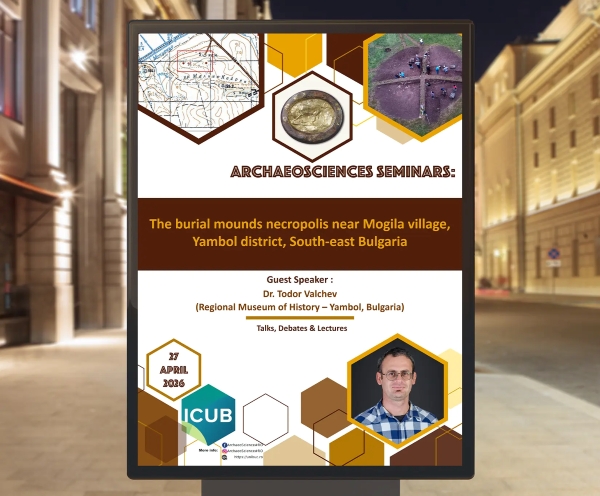
Luni, 27 aprilie 2026, Institutul de Cercetare al Universității din București (ICUB) vă invită la cel de-al 51-lea seminar ArchaeoSciences. Invitatul acestei ediții este Dr. Todor Valchev de la Muzeul Regional de Istorie din Yambol, ce va ține o prelegere intitulată “The burial mounds necropolis near Mogila village, Yambol district, South-East Bulgaria”.
Seminarul va avea loc începând cu ora 11:00 (EET), în Sala de Seminar (fostul Ierbar) al Facultății de Biologie, corp Grădina Botanică (Intrarea Portocalelor nr. 3, demisol).
Despre prezentare
Obiectivul acestei prezentări este diseminarea rezultatelor excavării tumulilor funerari din Golemia Kayryak din apropierea satului Mogila, districtul Yambol. Situl este poziționat pe un promontoriu stâncos de aproximativ 750 m lungime și 250 m lățime ce domină valea râului Mochuritsa, un afluent al râului Tundzha. Necropola era compusă din șase tumuli funerari, dintre care cinci au fost excavați. Tumulul nr. 1, situat în extremitatea estică, era așezat pe marginea unei creste, în zona unei viitoare cariere de piatră. A fost săpat în 2004, cu mormintele primare datând din epoca timpurie a bronzului, iar cele secundare din epoca mijlocie a bronzului și din perioada medievală. Alți patru tumuli, numerotați de la 2 la 5, erau grupați în zona centrală a crestei, la aproximativ 370 m vest de tumulul nr. 1 și la doar câteva zeci de metri unul de celălalt. Dintre aceștia, tumulii nr. 4 și 5 au fost săpați în 2018, cu mormintele primare datând din perioada romană imperială. Tumulul nr. 3 a fost excavat în 2022, cu mormintele primare datând din epoca timpurie a bronzului, iar cele secundare din perioada târzie a bronzului și perioada târzie a fierului. În 2025 a fost excavat tumulul nr. 2, ce avea o înhumare primară din perioada romană. Ultimul tumul, nr. 6, este situat în extremitatea vestică a necropolei, pe marginea de vest a crestei, la aproximativ 140 m de grupul central. Acesta nu a fost încă excavat.
Diversitatea cronologică a necropolei este de mare interes științific, sacralitatea locului – utilizat în scop funerar din epoca timpurie a bronzului până în perioada medievală – fiind evidentă.
Dr. Todor Valchev este arheolog la Muzeul Regional de Istorie din Yambol, Bulgaria. Printre interesele sale științifice se numără și dezvoltarea societăților Epocii Bronzului în Peninsula Balcanică.
Aceste seminare sunt o inițiativă originală a Platformei ArchaeoSciences (ASp) din cadrul ICUB, care își propune să ofere un cadru de exprimare profesioniștilor din domeniul științelor arheologice din diferite părți ale lumii pentru a împărtăși cunoștințe și a transmite informații semnificative despre cele mai recente probleme referitoare la metodele și abordările actuale utilizate pentru studierea trecutului. De asemenea, reprezintă o șansă pentru studenții români de a afla mai multe despre diversele aspecte interdisciplinare ale arheologiei și arheoștiințelor.
ICUB invites you to the lecture „The burial mounds necropolis near Mogila village, Yambol district, South-east Bulgaria”, delivered by Dr. Todor Valchev from the Regional Historical Museum – Yambol, Bulgaria
On Monday, 27 April 2026, the Research Institute of the University of Bucharest (ICUB) invites you to the 51st ArchaeoSciences seminar. This edition’s guest speaker is Dr. Todor Valchev from the Regional Historical Museum – Yambol, who will present a lecture titled “The burial mounds necropolis near Mogila village, Yambol district, South-east Bulgaria”.
The seminar will take place starting at 11:00 (EET) at the at the Seminar classroom (former Herbarium) of the Faculty of Biology building at the Botanical Garden (Intrarea Portocalelor no. 3, basement floor).
About the presentation
The aim of this lecture is to present the results from the excavations of the burial mounds in Golemia Kayryak near Mogila village, Yambol district. It’s situated on an elevated rocky spur about 750 m long and 250 m wide, overlooking the Mochuritsa River Valley, a left tributary of the Tundzha River. The necropolis was composed of six burial mounds, of which five were excavated.
The eastern-most situated mound no. 1 was placed on the edge of a ridge, in an area of a future quarry. It was excavated in 2004 with the primary graves dated to the Early Bronze Age and secondary graves from the Middle Bronze Age and Medieval period. Another four mounds, nos. 2–5, were grouped together in the central part of the ridge, about 370 m to the west of mound no. 1, placed just tens of meters from each other. From these, mounds nos. 4 and 5 were excavated in 2018, with the primary graves dated to the Roman Imperial period. Mound no. 3 was excavated in 2022, with the primary graves from the Early Bronze Age and secondary graves from the Late Bronze and Late Iron Age. In 2025, mound no. 2 was excavated, with a primary grave from the Roman Age. The last mound, no. 6, is the western-most mound of the necropolis, situated on the western end of the ridge, about 140 m from the central group. The mound has not yet been excavated.
The chronological diversity in the necropolis causes scientific interest, the sacredness of the place – which was used for funerary rites from the Early Bronze Age to the medieval period – being obvious.
Dr. Todor Valchev is an archaeologist at the Regional Historical Museum – Yambol, Bulgaria. His scientific interests include the development of the Bronze Age societies in the Balkan Peninsula.
These seminars are an original initiative of the ArchaeoSciences Platform (ASp) at ICUB, which aims to provide an open space for professionals in archaeological sciences worldwide to share knowledge and engage with the latest methodological and theoretical advances in the study of the past. They also offer Romanian students a valuable opportunity to discover the interdisciplinary dimensions of archaeology and archaeosciences.