


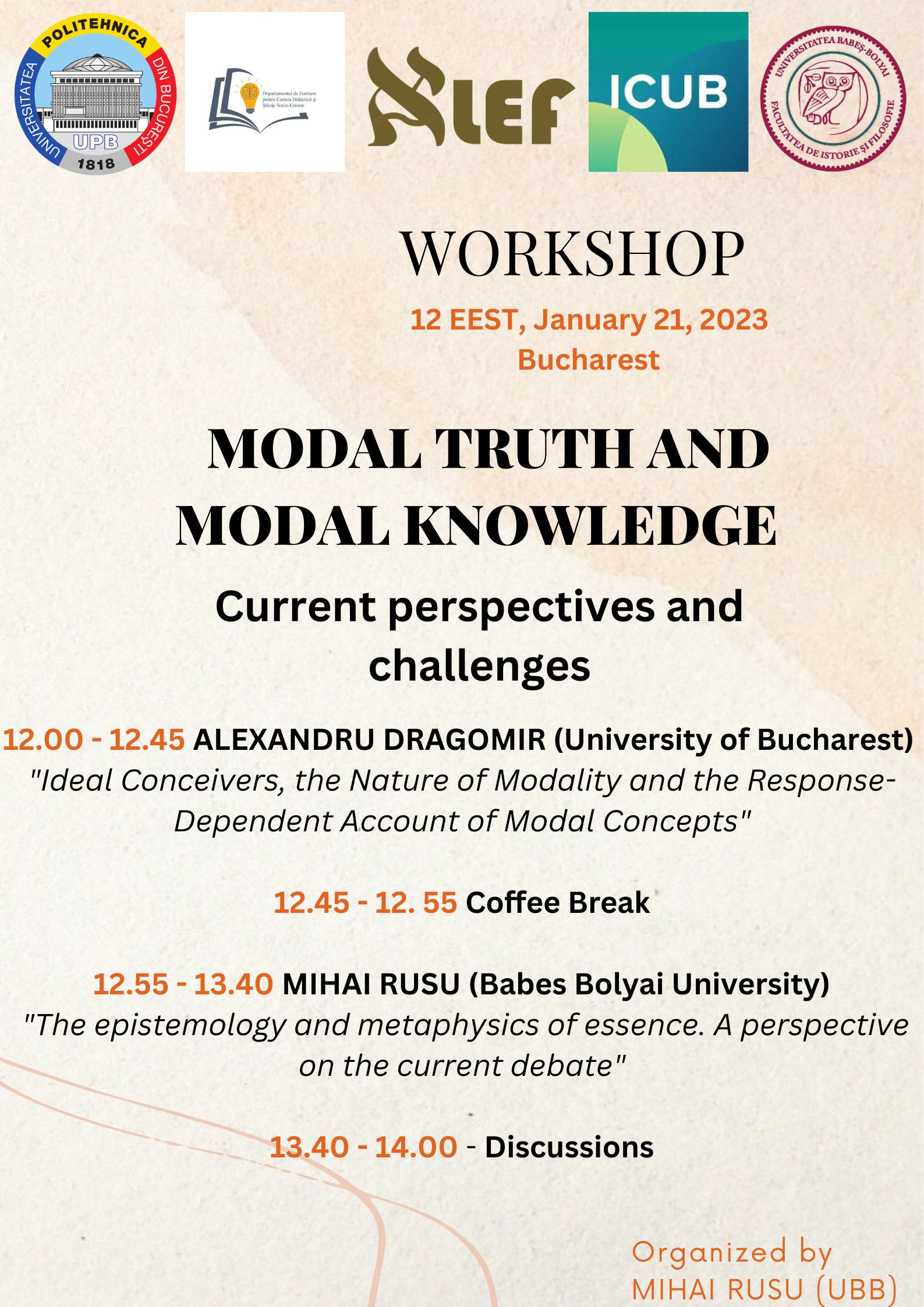
 Saturday, 21 January 2023, 12.00, Hybrid: Zoom and ICUB Humanities (Dimitrie Brandza 1)
Modal epistemology has become in recent years the most active field of investigation for philosophers concerned with modal issues. Metaphysical debates about possible worlds and their inhabitants have given way in the forefront of contemporary literature to discussions about knowledge of modal truths and the various theories that purport to explain this kind of knowledge, whether it is treated as something substantial or secondary. Each epistemological theory has taken some notion to be explanatorily central to the acquisition of modal knowledge. Thus, there are three broad types of modal epistemology (see also Vaidya and Wallner 2021): conceivability theories, counterfactual accounts and principle-based accounts. In very recent years, modal epistemology seems to be intertwining more and more with modal metaphysics, and the focus appears to shift in both directions towards another kind of theory: Finean essentialism. The question of modal knowledge is reconsidered as a question about knowledge of essences. But there are also recent critiques of Finean essentialism, such as Bovey (2022), Leech (2018), Noonan (2018), Romero (2019), Van Cleve (2018) and Wildman (2021), which attack Finean essentialism directly, by exploiting in different ways this perceived inability of the Finean to explain modality through essence. Wallner (2020) and Wallner and Vaidya (2020) are reactions to some of these criticisms. The defense of Finean essentialism is based on questioning the idea that the necessity of essentialist truths cannot be explained again by appealing to the essence of the target object or of other objects, on pain of vicious circularity. This workshop will explore the contemporary landscape of modal epistemology and metaphysics, trying to assess and discuss the most salient theories, their consequences and the perspectives for extending and developing current ideas and proposing new research themes. Presumably, these questions and ideas should also reflect on some fundamental issues and notions, such as truth, Gettier cases for knowledge, various forms of skepticism, etc.
Participants: Alexandru Dragomir (UB), Mihai Rusu (UBB).
Join Zoom Meeting