


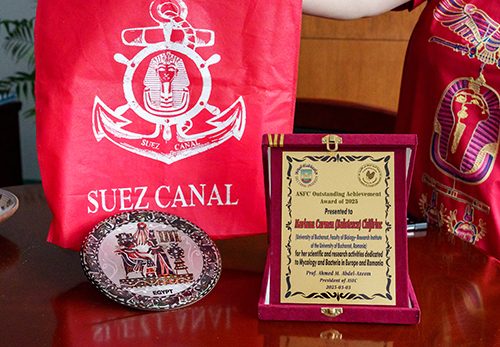
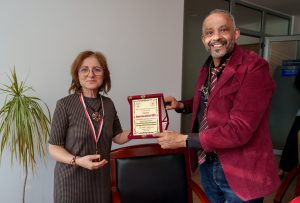
Professor Carmen Chifiriuc, vice-rector for Research of the University of Bucharest and professor at the Faculty of Biology of UB, received the Arab Society for Fungi Conservation (ASFC) Award for 2025.
Presented by ASFC President Dr. Ahmed M. Abdel-Azeem, the award was given in recognition “to her outstanding contributions to the field of microbiology, not only in Romania but across the globe”.
As stated in the award speech, “the ground-breaking research of professor Chifiriuc has significantly advanced our understanding of microbial ecosystems, their interactions, and their critical role in both environmental and human health. Her dedication, innovation, and unwavering commitment to science have inspired countless researchers and have left an indelible mark on the scientific community.”
More information about the ASFC Awards and the winners from the previous years are available here.
Mariana Carmen Chifiriuc is vice-rector for Research of UB starting with 2019 and coordinator of the Research Institute of the University of Bucharest. Professor at the Faculty of Biology of the University of Bucharest, she teaches courses of Microbiology and Immunology and supervises PhD thesis in Biology. She started her research career in 1997, as a microbiologist in the National Institute for Research and Development in Microbiology and Immunology “I. Cantacuzino” of Bucharest, Romania. She received fellowships from the International Network of Pasteur Institutes and Associates (Bangui – 1999, Paris – 2000).
PhD thesis: Host-parasite relationship. Opportunistic infections in HIV-infected patients (2005).
From 2001 to 2009, she was the National Data Manager for Romania in EARSS (European Antimicrobial Surveillance System). In 2003, she started the teaching career at the University of Bucharest, Faculty of Biology.
She was and is the coordinator of numerous internal and external financing grants. She is also a member of the research team in many national and international projects.
She is mentioned in Top World Ranking of Scientists 2% of most cited scientists in the world.
Main research focuses on investigation of the clinical/environmental reservoir of virulence and AR by phenotypic and genotypic tools, investigation of host-pathogen crosstalk during the infectious process, assessment of the antimicrobial activity of novel antimicrobial compounds, including nanostructures and nanomaterials.