


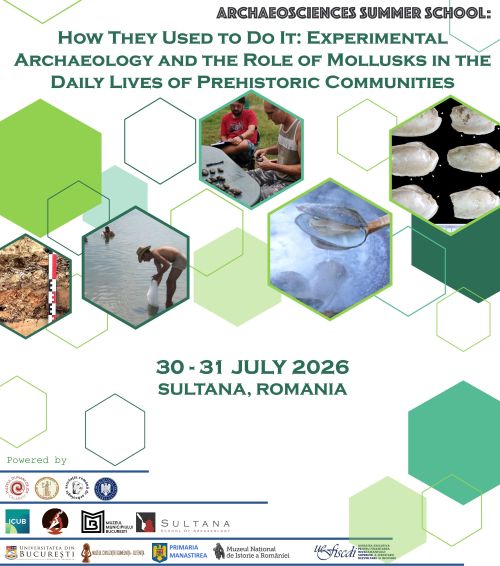
(English version below)
În perioada 30-31 iulie 2026, va avea loc, în cadrul Șantierului arheologic Sultana-Malul Roșu (județul Călărași), cea de-a 9-a ediție a Școlilor de Vară ArchaeoSciences, intitulată „Arheologie și moluște ”.
Evenimentul este organizat de Platforma ArchaeoSciences (ASp) a Institutului de Cercetare al Universității din București (ICUB), în cadrul proiectului de cercetare interdisciplinar Primele populații stepice nord-pontice în Balcani. O perspectivă bioarheologică a comunităților Cernavodă I din bazinul Dunării de Jos (Romania), nr. 77PCE/2025, cod PN-IV-P1-PCE-2023-1899.
Desfășurat în cadrul inițiativei „Școala de Arheologie de la Sultana”, evenimentul este dedicat în primul rând studenților implicați în activitățile arheologice din cadrul sitului.
Repere din program
- metodologie zooarheologică și ateliere practice cu resturi faunistice.
- moluște și ceramică; reconstituirea experimentală a chaîne opératoire pentru realizarea de vase ceramice având ca degresant cochilii de bivalve.
- utilizarea experimentală a moluștelor ca materie primă pentru realizarea de unelte (lamă, răzuitoare, netezitoare, recipiente) și analiza uzurii prin microscopie optică și material de referință.
Evenimentul este coordonat de dr. habil. Valentin Radu, drd. Bogdan Radu Manea, drd. Sebastian Valeriu Dumitrescu și dr. Cătălin Lazăr (Universitatea din București, ISDS București).
Programul integral al evenimentului
Joi, 30 iulie 2026, orele 10-11
Segmentul I: „De la scoică la vas: Reconstituirea Chaîne Opératoire a producției ceramice cu degresant din scoică
Coordonator: Drd. Bogdan Manea Școala Doctorală de Studii Interdisciplinare – Unibuc (ISDS-UB)
Modulul experimental își propune reconstituirea unei secvențe tehnologice complete (chaîne opératoire) implicată în fabricarea materialului ceramic cu degresant din scoică, specific materialului arheologic atribuit grupului Cernavodă I. Modulul pune accent pe prelucrarea și încorporarea valvelor de scoică în pasta de lut, tehnicile de modelare în lut și alte etape tehnologice.
Activitățile experimentale vor include procurarea și selectarea argilei și cochiliilor de moluște de apă dulce adecvate taxonomic; pisarea scoicilor utilizând diferite tehnici și tipuri de unelte (piatră, os, corn, lemn și alte instrumente specializate); compararea metodelor de fragmentare a scoicilor și a caracteristicilor degresantului rezultat; prepararea pastelor ceramice cu diferite rețete de utilizare a scoicii și proporții de degresant; modelarea, uscarea și arderea vaselor și finisarea suprafeței.
Prin compararea tiparelor de fragmentare experimentală și arheologică a scoicilor, documentarea comportamentului degresantului din scoică pisată pe parcursul procesului de fabricație (modelare, uscare și ardere) și evaluarea avantajelor și limitărilor acestuia, ne propunem să îmbunătățim înțelegerea alegerilor tehnologice populațiilor preistorice și a tradițiilor tehnologice de producție.
Vineri, 31 iulie 2026, orele 10-11
Segmentul II: „Mai mult decât o sursă de hrană: Utilizarea experimentală a valvelor de bivalve de apă dulce ca unelte versatile de tăiere, netezire și răzuire”
Coordonator: Drd. Sebastian Dumitrescu, Școala Doctorală de Studii Interdisciplinare – Unibuc (ISDS-UB)
În cadrul acestui atelier, studenții vor explora studiul experimental și interdisciplinar al uneltelor din scoică—valve de bivalve cu muchii ascuțite utilizate ca unelte de tăiere, răzuire și netezire, utilizate de grupurile neolitice și eneolitice din spațiul Dunării de Jos. Prin prelucrarea și utilizarea specimenelor moderne pe diferite materiale, participanții vor examina formarea uzurii prin corelarea gesturilor specifice, materialelor prelucrate și proprietăților fizice ale scoicii (grosime, stare de conservare, unghiul muchiei, etc.) cu urmele de utilizare rezultate și micro-morfologia acestora. Depășind analizele funcționale tradiționale, această abordare implică studenții în aspectele biomecanice ale utilizării uneltelor pentru a înțelege mai bine alegerile tehnologice preistorice și complexitatea activității umane din trecut.
Activitățile experimentale pot include netezirea și lustruirea ceramicii, prelucrarea materialelor organice (plante, lemn, carne, pește), prepararea pigmenților și utilizarea scoicilor ca recipiente. De asemenea, participanții vor avea experiență directă cu provocările unice generate de natura fragilă a artefactelor din scoică, inclusiv diferențierea uzurii antropogene de modificările naturale post-depoziționale. Datele rezultate vor constitui ulterior baza unui studiu arheometric post-atelier care va implica analize SEM-EDS și microscopie optică pentru a evidenția micro-striațiile și deformările sub-structurale.
Experimentele își propun să îmbunătățească înțelegerea diversității funcționale a cochiliilor de moluște și să contribuie la interpretări mai solide ale artefactelor din scoică descoperite în contexte arheologice preistorice.
Școlile de Vară ArchaeoSciences este o inițiativă recentă destinată studenților, masteranzilor și doctoranzilor, oferind introduceri aplicate în metodele interdisciplinare de cercetare a trecutului.
ArchaeoSciences Summer School 2026: “How They Used to Do It: Experimental Archaeology and the Role of Mollusks in the Daily Lives of Prehistoric Communities”
On July 30-31, 2026, the 9th edition of the ArchaeoSciences Summer School, entitled “Arheologie și Moluște”, will take place within the Sultana-Malul Roșu archaeological site (Călărași County, Romania).
The event will be organized by the ArchaeoSciences Platform (ASp) of the Research Institute of the University of Bucharest (ICUB), as part of the interdisciplinary research project First North Pontic Steppe Populations in the Balkans. A bioarchaeological outlook of Cernavodă I communities in the Lower Danube Basin (Romania), no. 77PCE/2025, code PN-IV-P1-PCE-2023-1899.
The event, conducted within the framework of the “Sultana Archaeology School” initiative, are primarily dedicated to students involved in archaeological activities at the site.
Program Highlights
- zooarchaeological methodology and hands-on workshops with faunal remains
- mollusks and ceramics; experimental reconstruction of the Chaîne Opératoire for manufacturing shell-tempered pottery vessels
- experimental use of mollusks as raw material for tool production (blades, scrapers, smoothers, containers) and use-wear analysis through optical microscopy and reference material.
The event is coordinated by Dr. Habil. Valentin Radu, PhD candidate Bogdan Radu Manea, PhD candidate Sebastian Valeriu Dumitrescu, and Dr. Cătălin Lazăr (University of Bucharest, ISDS Bucharest).
Full Program Schedule
Thursday, July 30, 2026, 10:00–11:00
Segment I: “From Shell to Pot: Reconstructing the Chaîne Opératoire of Shell-Tempered Pottery Production”
Coordinator: Bogdan Manea (PhD Candidate, Doctoral School of Interdisciplinary Studies – University of Bucharest, ISDS-UB)
This experimental module reconstructs the complete technological sequence (chaîne opératoire) involved in the manufacture of Cernavodă I shell-tempered pottery, with particular emphasis on the processing and incorporation of crushed shell valves into the clay paste.
Experimental activities will include the procurement and selection of suitable clay and freshwater mollusks shells; shell crushing using different techniques and tool types (stone, bone, antler, wooden, and other experimental implements); comparison of shell fragmentation methods and resulting temper characteristics; preparation of ceramic pastes with different shell recipes and temper proportions; vessel shaping, drying and firing and surface finishing.
By comparing experimental and archaeological shell breakage patterns, documenting the behaviour of crushed shell temper throughout manufacture (vessel forming, drying, and firing), and evaluating its advantages and limitations, we aim to improve our understanding of prehistoric technological choices and production traditions.
Friday, July 31, 2026, 10:00–11:00
Segment II: “More than a Food Source: Experimental Use of Freshwater Bivalve Valves as Versatile Cutting, Smoothing, and Scraping Tools”
Coordinator: Sebastian Dumitrescu (PhD Candidate, Doctoral School of Interdisciplinary Studies – University of Bucharest, ISDS-UB)
Within this workshop, students will explore the experimental and interdisciplinary study of shell blades—sharp-edged bivalve valves used as cutting, scraping, and smoothing tools in prehistoric contexts. By working with modern specimens on different materials, participants will examine wear formation by linking specific gestures, worked materials, and shell physical properties (thickness, curvature, edge-angle) to the resulting use-traces and micro-morphology. Moving beyond traditional use-wear analyses, this approach engages students with the biomechanical aspects of tool use to better understand prehistoric technological choices and the complexity of past human activity.
Experimental activities may include pottery smoothing, processing of organic materials (plant, wood, meat, fish), pigment preparation, and the use of shells as containers. Additionally, participants will have firsthand experience with the unique challenges posed by the fragile nature of shell artefacts, including distinguishing anthropogenic wear from natural post-depositional modifications. Resulting data will subsequently form the basis of a post-workshop archaeometric study involving SEM-EDS and optical microscopy analysis to reveal micro-striations and sub-structure deformation.
The experiments aim to improve our understanding of the functional diversity of mollusks shells and contribute to more reliable interpretations of shell artefacts recovered from prehistoric archaeological contexts.
The ArchaeoSciences Summer Schools are a recent initiative dedicated to students, Master’s, and PhD candidates, offering applied introductions to interdisciplinary methods of researching the past.