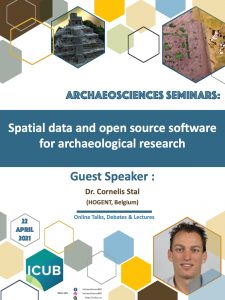
The Division of ArchaeoSciences – the Research Institute of the University of Bucharest (ICUB) is pleased to announce the 17th ArchaeoSciences Seminar.
These seminars are an original initiative of our division that has the goal of providing a setting for professionals in the Archaeological Sciences field from different parts of the world, to share knowledge, and transmit meaningful information about the latest issues regarding the current methods and approaches used to study the past. It is also a chance for Romanian students to learn more about the various interdisciplinary aspects of archaeology.
This seminar will take place on 22 April 2021, online, and our guest speaker is Dr. Cornelis Stal from HOGENT University of Applied Sciences and Arts (department of Built Environment), Digital Manager of Heritage, Ghent (Belgium).
He will give an online presentation entitled “Spatial data and open-source software for archaeological research”.
Cornelis Stal is lecturer and researcher at the HOGENT University of Applied Sciences and Arts (department of Built Environment), Digital Manager of HERITΛGE, and Visiting Professor at the Ghent University (Department of Geography) with a significant experience in the field of the combination, processing and quality analysis of airborne and terrestrial laser scanning and photogrammetry for 3D modeling. His special interests lie in the (automatic) generation of geometric, radiometric and semantic rich 3D models, derived from irregular point sets and other spatial data sets. Both laser scanning and photogrammetry, as well as geo-IT (GI-systems, GI-programming, GI-management) are important pillars of his research. Other research opportunities have allowed him to build additional expertise in geomatics applications for bathymetric modeling. He has played a significant role in the maritime SBO project SEARCH (Archaeological Heritage at the North Sea) and CREST (Climate Resilience Coast), as well as the analysis of GNSS data from tidal buoys. He also worked on the development of processing algorithms for tunnel measurements using laser scanning. Currently, he has a special focus on the digital 3D documentation of cultural heritage and the management and publication of these data in online environments. Given his expertise in heritage modeling, he manages the Heritage Management Organization Digital program, where he participates in multiple research projects and summer schools.
His lecture will explore an exciting topic about the use of geomatics and spatial images in archaeological investigations, and what information it can provide for a better research.
Early implementations of these disciplines frequently relied on commercial software and expensive data sources, which resulted in a relatively high cost in terms of financial and human-ware resources. To date, we see a tendency towards open-source software and data, which is heavily simulated by a large community of interdisciplinary software developers, but also by the FAIR data policy as implemented by many governmental organizations.
In this presentation, some applications of geomatics for digital humanities will be presented, focusing on data acquisition, processing, and publication. Some interesting open-source applications will be discussed that were successfully used in these projects. The idea of this presentation is not to give a demo about the software itself, but more to give a short overview of the great opportunities that can be explored by mastering these great tools.
Due to the special measures imposed by COVID-19 pandemic, the lecture will be online, on 22/04/2021, starting at 11:00 am (EET), via Google Meet Platform:
meet.google.com/yos-rmqg-gud
We look forward to exciting discussions!
ArchaeoScience#RO Team