


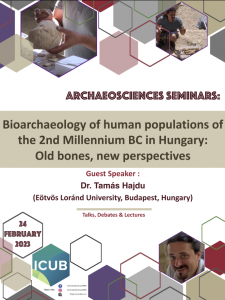
The Research Institute of the University of Bucharest (ICUB), in collaboration with ‘Francisc J. Rainer’ Anthropological Institute of Romanian Academy, is pleased to announce the 28th ArchaeoSciences Seminar.
These seminars are an original initiative of our platform that aims to provide a setting for professionals in the Archaeological Sciences field from different parts of the world to share knowledge and transmit meaningful information about the latest issues regarding the current methods and approaches used to study the past. It is also a chance for Romanian students to learn more about the various interdisciplinary aspects of archaeology.
This seminar will take place on 23 February 2023 at 11:00 am (EET), and our guest speaker is Dr. Tamás Hajdu from Eötvös Loránd University (Hungary).
He will give a lecture entitled “Bioarchaeology of human populations of the 2nd Millennium BC in Hungary – Old bones, new perspectives period”.
Tamás Hajdu received his Ph.D. from the Eötvös Loránd University, Budapest, in 2012 and has worked at Eötvös Loránd University since 2009. He is a physical anthropologist and bioarchaeologist. He is an associate professor and the head of the Department of Biological Anthropology at Eötvös Loránd University. He specializes in the population history of Eastern Central Europe in prehistory (mainly Bronze and Iron Ages) and the Migration Period, as well as in the evolution of infectious diseases and palaeo-oncology. In the last 15 years, he has worked in Italy, Croatia, and Romania within the framework of international projects and led several bioarchaeological projects in Hungary. He collaborates with the world-leading stable isotope and aDNA researchers and laboratories to explore the exact demographical, cultural, and biological changes.
The current lecture will investigate the material culture of Hungary in the 2nd Millennium BC, which has revealed several examples of cultural changes. For instance, the appearance of the Tumulus Grave Culture (1500-1300 BC) is a very important change since, in this period, a relatively unified archaeological culture could be observed in almost the entire territory of today’s Hungary. It is not yet entirely clear whether the appearance of the Tumulus Grave Culture is a consequence of immigration or a kind of cultural transition of the autochthonous local groups. However, the appearance of the Tumulus Grave Culture resulted in the abandonment of the tell settlements alongside a gradual increase in the number of horizontal settlements. It is still to be established whether there was a shift from farming to animal husbandry and whether the changes in settlement structure are related to the transformation of the subsistence strategy. Our project aims to answer these questions relating to subsistence strategy, diet and mobility of the ancient human groups who lived in the Great Hungarian Plain during the 2nd Millennium BC.
This event will take place Thursday, 23 February 2023, starting at 11:00 am (EET) at the Faculty of Biology, in the Conference Room of the Research Platform in Biology and Systematic Ecology (Splaiul Independenței, no. 91-95, Bucharest).
We look forward to exciting discussions!
ArchaeoScience#RO Team