


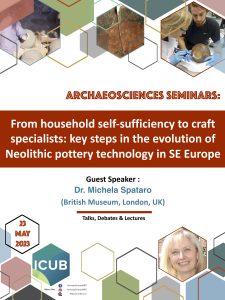
The Research Institute of the University of Bucharest (ICUB) is pleased to announce the 32nd ArchaeoSciences Seminar.
These seminars are an original initiative of the ArchaeoScience#RO Platform at ICUB that aims to provide a setting for professionals in the Archaeological Sciences field from different parts of the world to share knowledge and transmit meaningful information about the latest issues regarding the current methods and approaches used to study the past. It is also a chance for Romanian students to learn more about the various interdisciplinary aspects of archaeology.
This seminar will take place on 23 May 2023 at 11:00 am (EET), and our guest speaker is Dr Michela Spataro from British Museum (UK).
She will give a lecture entitled “From household self-sufficiency to craft specialists: key steps in the evolution of Neolithic pottery technology in southeastern Europe”.
Dr. Michela Spataro is a scientist in the Department of Scientific Research at the British Museum (London, UK). Previously, as a Leverhulme Research Fellow at the Institute of Archaeology, she completed an archaeometric project on the earliest pottery from the central Balkans, the Starčevo culture. She has a degree in Literature and Philosophy and a PhD in archaeology from the Institute of Archaeology, University College London (UK). One of her main interests is the ceramic chaîne opératoire of the early pottery production communities, to understand the social, political and economic aspects of these societies. As well as working in southeastern Europe, she has worked on ceramics from Russia, Pakistan, Turkey, Iran, Syria, Afghanistan, Egypt and Sudan. In addition, she organised several international symposia on the Balkan Neolithic and ceramic technology. She supervises PhD students and is the academic mentor of a post-doctoral researcher. She published two monographs, four co-edited volumes, and more than 70 articles on pottery studies.
In the planned lecture, she will present the valences of the archaeometric analyses as essential tools for detecting detailed socio-economic patterns. In this context, the study of the ceramic production sequence (the chaîne opératoire) provides insights into the socio-economic organisation of past communities. This talk will focus on how the study of the ceramic chaîne opératoire suggests how Neolithic communities in southeastern Europe changed from the early to the middle/late Neolithic, from household production to a more sophisticated and specialised technology. As well as technological changes in the chaîne opératoire, attention will be drawn to how the southeastern European potters adopted steps in the ceramic sequence which differed from those of neighbouring communities and contrasted with those of contemporaneous hunter-gatherer pottery groups in northern Europe. The development of this art craft reflects different networks and dynamics, which are at the base of persistent traditions and conservatism in early Neolithic communities, opening to changes and innovation on a wider scale around 5400 cal BC.
This event will take place Tuesday, 23 May 2023, starting at 11:00 am (EET) at the Rectorate building, ground floor, Bucharest University Senate Hall (Șos. Panduri, no. 90, 050663, Bucharest).
We look forward to exciting discussions!
ArchaeoScience#RO Team